You’ve Heard of the Authoritarian Playbook. It’s Time We Got Our Own.
Democratic institutions across Europe are under attack, but new research is starting to show how to defend them. Now, we're building a program to act on it.

Democracy is losing ground.
According to the V-Dem Institute, autocracies now outnumber democracies globally for the first time in over two decades. The 2026 V-Dem report identified six new autocratizing countries, including Italy, the United Kingdom, and the United States.
Europe is no exception: fifteen European countries are in active democratic decline, seven of them inside the EU. Across the continent, a well-funded authoritarian playbook is being deployed with increasing coordination: packing courts with loyalists, rewriting election rules, threatening politicians, pressuring independent media, and defunding civil society. Authoritarian leaders actively share these tactics with one another.
The democratic defense side has been catching up, with recent efforts like D-HUB's Anti-Authoritarian Toolkit map of over fifty counter-plays. But the organizations on the front line — legal advocacy groups, election monitors, press freedom watchdogs — are often small, chronically under-resourced, and isolated from one another. The field has lacked a shared playbook of its own: a systematic way to identify which tactics work, in which contexts, and where added talent and resources can make the biggest difference.
That's starting to change. New research is making it possible, for the first time, to compare democratic interventions across contexts and prioritize where capacity will matter most. At The School for Moral Ambition, a nonprofit that redirects skilled professionals to where they're needed most, we've spent the past year and a half building a process to act on that research. We think we've found one. Now we're putting it to work.
Democracy dying in darkness
In October 2024, my son was born, and I went on paternity leave. For the next two months, I did all the night feeds. A lot of hours in the dark, bottle in one hand, phone in the other.
I stayed up the full night watching the U.S. election results come in. Trump's second victory. One election like that might be a fluke. Two is the system. Days later, at four in the morning, I was reading about South Korea's president declaring martial law. A beacon of democratic stability, not on anyone's risk list, suddenly cracking. It resolved, thankfully. But the shock stayed.
In those same weeks: Georgia's government cracking down on protesters after disputed elections. Romania's constitutional court annulling a presidential election over alleged foreign interference. Mozambique descending into post-election violence.
I'd studied democratic representation as a political scientist and spent years in and around government before joining The School. Democracy had always been the water I swam in. But watching it erode in real time, from a chair in the dark, made it feel urgent in a way that academic papers never had.
At The School, democracy was already on our radar, one of ten global challenges on the reading list we pointed community members toward. But we'd never seriously asked: should we build a program here ourselves?
That cascade of crises changed things. On December 11th, before my leave was even over, I sat down and wrote the first pitch for a Democratic Resilience Fellowship.
The cause that underpins all others
The School for Moral Ambition runs fellowship programs that place skilled professionals inside civil society organizations working on the food transition, tobacco control, and tax fairness. I helped build this model as the program manager of our first Food Transition Fellowship, alongside a small team that designed the product from scratch. Much of our fellows' work touches EU-level policy, and that policy work lives or dies by the democratic environment it operates in.
Some real examples of obstructed work that my food transition fellows experienced: The European Commission, under pressure from the radical right, barred civil society organizations receiving LIFE programme funding from using those grants for advocacy work towards EU institutions, effectively gutting sustainability advocacy. Then there are the omnibus proposals: in 2025 the Commission published eight deregulation packages without impact assessments, shutting media and society out of big parts of the legislative process before it had even begun.
And authoritarian tactics influencing our work do not just come from within Brussels. In March 2025, a North Dakota jury ordered Greenpeace, one of our collaborators, to pay $660 million in damages to fossil fuel giant Energy Transfer — the culmination of a nine-year suit designed to drain an organization into silence. The effects of this lawsuit still echo, even in Brussels. These were kernels of democratic erosion we felt ourselves: packed courts, defunded critics, and legislative processes closed off from dissent.
This dynamic plays out at every level of government: when democratic institutions weaken, the space for civil society to operate shrinks. That realization pushed us to look beyond the EU institutions we were working with and toward the country level, where democratic institutions are built, eroded, and defended.
We tried, and we weren't ready
When I came back from leave, the pitch got a green light. We commissioned a scoping study with a university student research team: build us a comparative framework to compare democracy interventions across Europe. Which tactics are most effective, in which countries, for which kinds of threats?
That was five months of work, with a capable team. In the end, they got to about ten percent of where we needed to go to actually launch a program.
The problem is that the questions about what actually works best are still largely unanswered in the field. The academic literature on democratic decline is vast, but the operational translation is not. Which tactic, in which context, produces the strongest results for the resources invested?
A USAID-commissioned evidence gap map across six pillars of democracy showed that across 1,500 studies worldwide, evidence clusters overwhelmingly around civic education and voter information campaigns — not the institutional tactics like accountability monitoring or support for rights defenders where gaps are largest. Less than fifteen percent of these studies include any cost data. We know startlingly little about what works, where, and at what price.
So we decided to stop. The need was enormous, but we didn't yet have the evidence base to build a program on.
 The School for Moral Ambition
Power for Democracies
In parallel, we had been tracking Power for Democracies, an independent research institution co-founded by Markus Beeko, former Secretary General of Amnesty International Germany. P4Dem was working on exactly this translation problem: turning democracy research into prioritized recommendations for where resources and people can have the greatest impact.
We'd explored a collaboration in January 2025, but P4Dem hadn't published yet and couldn't take on another project. We were interested, but had no way to assess their work.
Then, in November 2025, P4Dem released their first set of recommendations. They had built a step-by-step research process. First, assess countries based on democratic threat, tractability, neglectedness, and opportunity. Then, identify which pro-democracy tactics show the most promise in each context. Finally, evaluate the specific organizations implementing those tactics.
Their first portfolio (and earlier work of their mother-organization Effektiv Spenden) included the Media and Law Studies Association in Turkey, which provides legal defense for roughly 150 journalists per year facing prosecution, keeping an independent press alive under severe pressure. In Germany, non-profit investigative media organization CORRECTIV published a single investigation in January 2024 exposing the extreme right politicians’ ‘Geheimplan’ — triggering the largest pro-democracy street protests in German history. And in Kenya, Ushahidi built open-source crisis-mapping technology that lets citizens report electoral fraud and violence in real time via SMS, that is now used all over the world. In Nigeria's 2011 elections, peer-reviewed research linked it to an 8% rise in voter turnout.
This was exactly the process we had tried to build ourselves on our first attempt. That’s why we immediately moved to formalize a partnership with P4Dem. A funder who believed in this approach backed a dedicated development phase, giving us three quarters of a year to do this properly.
Three choices we’ve made
That partnership made it possible to think bigger than a fellowship. Democracy is becoming a full cause area within The School, a program that helps our global community (over 25,000 sign-ups) understand where they can contribute, whether through a fellowship, their current careers, or the Moral Ambition Circles our members run worldwide.
The fellowship sits at the core, following the model we've proven in food, tobacco, and soon tax fairness: we recruit, select, train, and pay fellows; partner organizations gain skilled professionals without bearing the financial burden. Eighty percent of our fellows continue working in the cause area after their placement ends.
We had to make choices from the outset. Ask ten people what matters most in democratic defense and you'll get ten answers, most of which are defensible. That’s why we've made three strategic choices about where to focus:
- We begin in Europe, where our talent access is strongest.
- We work at the country level, strengthening the civil society organizations that hold democratic institutions together in the specific countries where added capacity can break the biggest bottlenecks.
- We focus specifically on building institutional democratic resilience against authoritarian strategies — countering democratic decline and enhancing democratic recovery — guided by where the evidence of impact and unmet need for capacity is strongest.
That last choice deserves a word of explanation. There are multiple worthy approaches to defending democracy: civic education builds long-term strength, democratic innovations like citizens' assemblies show real promise. We will likely focus on very targeted institutional strengthening, because that's where P4Dem's research so far sees the strongest evidence of impact and the greatest unmet need for capacity. Grassroots programs are expensive to scale per person reached. Innovations haven't yet been evaluated in ways that let us compare their impact at scale, and The School for Moral Ambition is a scaling organization. We deploy what's proven before we experiment.
Come build with us
We haven't found the answer yet. We've found a process to get to the answer, and we're going through that process one step at a time.
Our research collaboration with Power for Democracies has three milestones running through summer 2026: country selection, tactic selection, and civil society organization identification.
In parallel, we're reaching out to the people and organizations already doing this work. The democracy ecosystem has decades of experience, hard-won relationships, and institutional knowledge that we need to learn from before we can add anything meaningful.
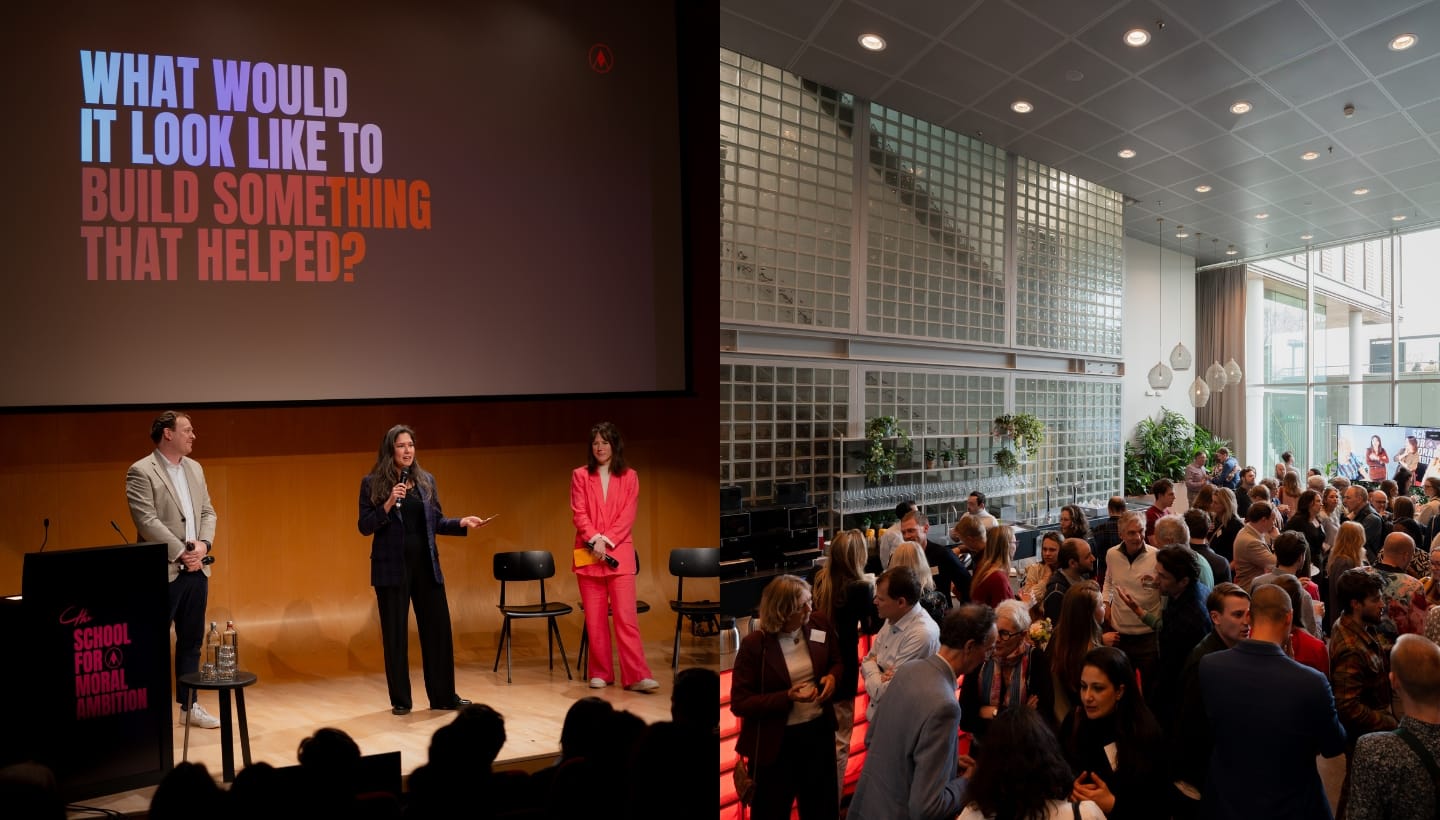
So we're meeting academics and practitioners, attending gatherings, reading what they've published, and asking honest questions about where an organization like ours could be most useful. When organizations tell us they're struggling with capacity, we want to understand what that looks like concretely, so that when we're ready to place fellows, we're solving problems they actually have.
In the second half of the year, we translate findings into program design and build the funding coalition to launch. The first cohort of democracy fellows is planned for September 2027.
We're sharing this now because we believe in building in the open, and because the people already working in this space are the ones who can help us get this right.
Two years ago, I was sitting in the dark, watching our democracies fall apart and wondering where someone like me could make a difference. That question drove everything that came after. If you've asked yourself the same thing, we want to build this with you.
Join us at community.moralambition.org, where we've created a dedicated democracy space to take anyone interested along on the journey. If you are an academic or practitioner in the European democracy space we should learn from: reach out.
Comments ()