Beyond the Easy Answers
Three Problems Holding Back Food System Change

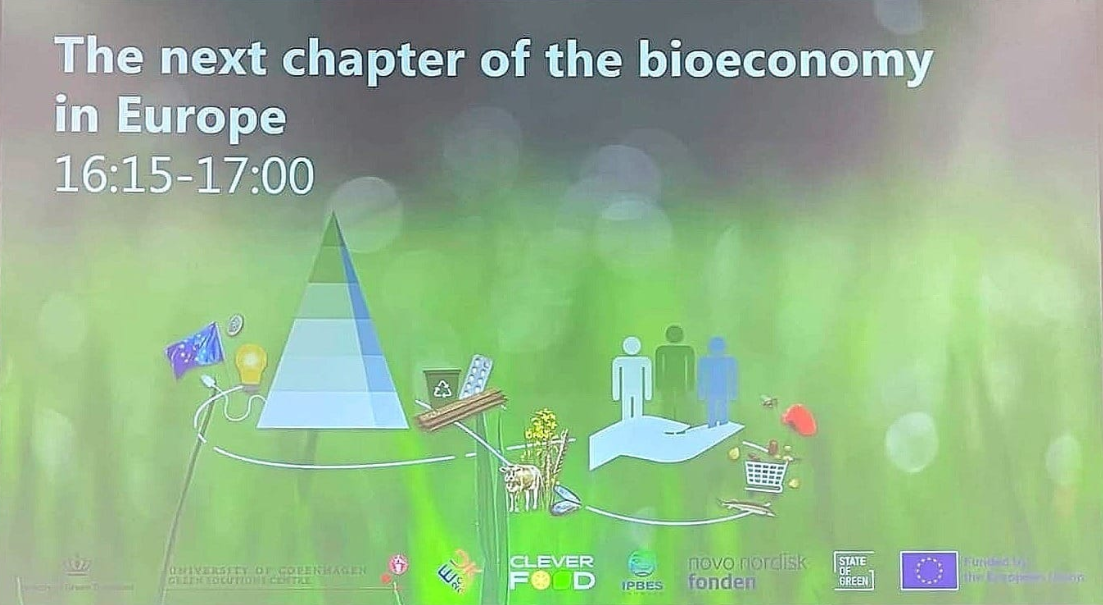
I was sitting in a bioeconomy conference in Copenhagen when something clicked for me about why advocacy in the NGO world can be so hard. The organisers had set up a live polling tool to crowdsource questions from the audience. Questions were pouring in about sustainable materials, circular economy, innovation funding. And buried in there, again and again, were questions about food: about agriculture's climate impact, about protein diversification, about the elephant in the room that everyone knew was there but nobody wanted to name (despite the most upvotes!).
The speakers, many from the European Commission, fresh from leading work on the newly released Bioeconomy strategy, scrolled right past them all. Kiri (another fellow from The School for Moral Ambition who was sitting next to me) and I exchanged looks and some less than polite words. Here was the bioeconomy (literally the economy of biological resources) and the people shaping EU policy were actively avoiding the biggest piece of it.
However, when startup founders from the alternative protein space spoke up, suddenly there was attention: thoughtful responses, genuine engagement. Those industry voices ended up being the ones to address the food questions the Commission had dodged, which only made the avoidance more glaring. This wasn't about the quality of the questions, it was about who was asking.
For my fellowship I'm placed at the Good Food Institute Europe (GFIE), a 50 person non-profit NGO/think tank team doing impressive work in the alternative protein space. I wasn't new to impact work when I joined The School for Moral Ambition's Food Transition Fellowship; I'd already spent years working in sustainability and NGOs. So for me, this wasn't about becoming a do-gooder, but about exploring agri-food systems, understanding the EU policy environment, and meeting people genuinely committed to making things better. Since arriving at GFIE, I've been trying to understand how change actually happens (or perhaps more accurately why systems resist change). I’ve done this in part through a systems mapping project and in the process of building a casual loop diagram and sharing some of the learnings with others in the space, I've gathered not only some interesting insights around under-explored leverage points, but also the clarity that we're facing three problems in particular.
1: The messenger problem
Copenhagen showed me this. Decision-makers are set up to engage with certain types of messengers: when those startup founders spoke up, they got attention not just because they had polish, but because they are credible, and policymakers recognise that.
Civil society, meanwhile, is fighting uphill with the evidence and the arguments, but operating through advocacy channels and representatives that decision-makers have sometimes learned to filter out. More evidence doesn't solve this. Better arguments don't either. The messages needs new messengers.
In system mapping terms this shows up in a number of ways for different stakeholders, but perhaps the most important common theme is that as behavioural psychology shows, we often process information through identity rather than evidence.
2: The purity problem
This isn't the first time I've seen this pattern (I watched it in other NGO contexts), but in food systems, the fractures are particularly sharp. I’ve heard debates about where we're headed: depending on the motivation for food system change, some are unwilling to discuss anything except a total end to animal agriculture, while others think the only realistic goal is just producing less meat. Then there are debates about how we get there: do we embrace innovation even when it makes us uncomfortable (lab-grown meat, precision fermentation), or do we hold the line and stick to what we know and trust? And there are debates about who we work with: is building coalitions with corporates and using their scale to serve our mission pragmatic, or is it an unacceptable compromise?

These aren't trivial questions, they're real tensions about values and strategy, but when they become a primary activity, and more energy goes into debating purity than into coordinating action, something has gone badly wrong. As Rutger Bregman himself said in his recent BBC Reith Lectures, "The left has turned inward, fragmenting into ever smaller moral circles. It has become quick to cancel, slow to compromise, quick to judge, slow to persuade."
In civil society, you often don't get the feedback that tells you whether your approach or theory of change is working. Did that policy brief influence the decision, or would it have happened anyway? Is awareness growing because of your communications, or despite them? When you can't see clear progress, the natural human response is to become more certain, not less. This protects investment in the approach, but it also makes it harder to learn and creates deep entrenchment. Conviction about what you're doing matters, but the cost is that it becomes harder to notice when evidence suggests a different approach might work better, or when coordination with people using different strategies might achieve more than either could alone.
None of us actually knows how to make these enormous shifts happen. That uncertainty is uncomfortable, and moral purity resolves this discomfort. It provides a sense of certainty about something even when effectiveness is fundamentally uncertain. But it is like turning up to fight with only a shield. At the end of the day, what matters more: being morally pure or actually making progress? Having the correct analysis or actually limiting harmful industrial animal agriculture? Maintaining ideological consistency or actually achieving a tobacco endgame? By the measure that actually counts (outcomes), we are failing.
3: The infrastructure problem
Peter, on the tobacco fellowship, recently described attending a major policy event where another real issue became visible. Civil society groups weren't just outmatched on resources, they were drowning in information they were trying to synthesise with inefficient coordination between organisations. There was no strong, shared infrastructure for turning all that expertise into coherent input, and meanwhile they were up against an industry machine that had its messaging locked down and its responses coordinated.
It's not that civil society lacks intelligence or commitment, but it is trying to do complex work without some pretty key infrastructure. Ostensibly groups are on the "same side" but working in separate silos, duplicating effort, unable to pool resources or build on each other's analyses in real time. Even when we can move past purity and find compromise, the tools and systems we need to actually coordinate at scale - synthesise information, align without requiring unanimity and present coherent alternatives - largely don't exist.
What this means
I don't think these problems have simple solutions. But I think recognising them changes what questions we need to ask.
The messenger problem isn't solved by being louder or having better evidence; it requires different approaches for how knowledge reaches decision-makers. The fragmentation problem isn't solved by everyone agreeing on everything; it requires finding ways to coordinate even across different theories of change, and being honest about when purity debates are helping versus when they're just eating energy that could go toward actual change. The infrastructure problem isn't solved by working harder in silos; it requires building the actual tools and systems that let us integrate diverse knowledge, coordinate without demanding consensus, and generate meaningful alternatives at the moments when decisions get made.
I'm exploring what it looks like to work on these things, not because I have answers, but because I'm convinced that recognising these problems is the first step toward actually addressing them. The fellowship has given me space to think about the difference between working within systems and building new ones, between reform and transformation, between what we wish would work and what actually might.
If you're hitting similar walls, or thinking about the gap between what advocacy is set up to do and what transformation actually requires, I'd genuinely like to hear about it. Not to commiserate, but to explore what building for transformation actually looks like in practice.
Because more of the same - no matter how well executed - isn't going to get us there.
Comments ()